Count the Clutter Before You Buy the Bin: A 20-Minute Pre-Shop Audit
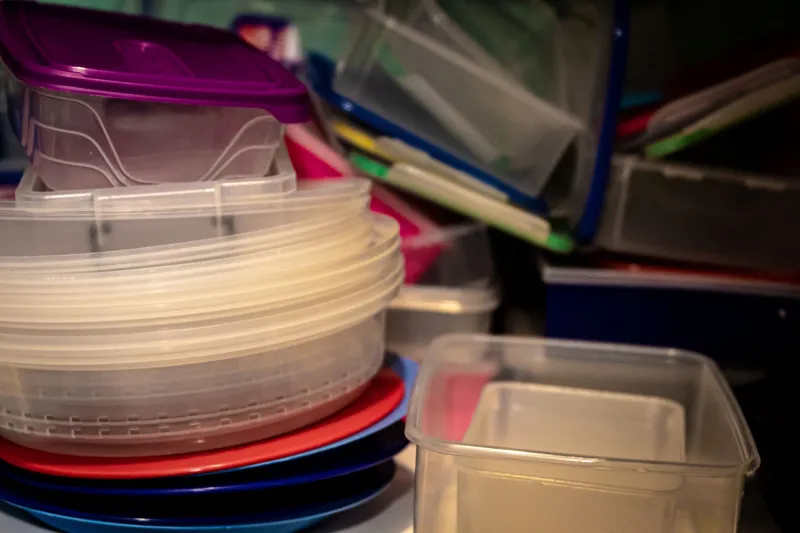
Somewhere in your house right now there is a bin holding six things it doesn't need to hold, sitting on a shelf that could've held those six things directly. I know this because I have four of them. And I bought them on purpose, for $14.99 each, believing I was being organized.
That's the organizer tax: paying real money to relocate clutter a few inches to the left, then paying again in shelf space, then again in the mild guilt of owning a labeled tub full of nothing. The fix isn't a better bin. It's a count you do before you add anything to a cart.
First, the number nobody puts on the shelf tag
Storage aisles sell you capacity in quarts and gallons. Your house runs on a different metric: cost per item actually stored.
Do the division and the picture gets uncomfortable. An $18 open-top bin holding six items costs you $3 per thing put away. A $34 stackable tower holding forty items runs about $0.85 each. Same aisle, same brand family, wildly different economics — and that's before you count the bin that ends up storing three chargers and a hair dryer for the next four years.
Then there's the worst category, the infinite one: a bin whose contents already had a perfectly good home. Cost per item stored? Undefined. You bought a box to hold something that was already being held.
Most of us shop the aisle by look — the photo of the pristine linen closet, the color-coordinated stack. Shopping by math is rarer and considerably cheaper. So run the math first, on paper, before you leave the house.
Step one: the 20-minute room count
Pick one room. Set a timer for five minutes. Walk the perimeter and write down, in plain language, what's out of place. Not categories — counts. "Eleven cables," "nine bags of yarn," "two drawers of mail," "a tote of things that belong in the garage."
Do four rooms, five minutes each. That's your 20 minutes, and it will produce a list that is almost always smaller and more specific than whatever you were imagining when you opened the browser tab.
A few rules that keep the count honest:
- Count items, not piles. "A pile of papers" is a feeling. "Roughly 60 pieces of paper" is a decision you can act on.
- Note the home each thing is missing. Cable that belongs in the office is not the living room's problem, and a bin in the living room won't fix it.
- Mark duplicates. Three rolls of tape in three rooms is not a storage failure. It's a you-keep-buying-tape problem, and that's a grocery-list fix, not a $40 acrylic one.
- Flag anything you can't name in two seconds. If you can't identify it, you certainly can't organize it.
When you're done, total the counts. That number is your actual storage problem. Everything you were about to buy has to justify itself against it.
Step two: the $0 pass
Here's where the cart usually dies. Before buying anything, empty every container you already own onto the floor — the shoeboxes, the takeout containers, the gift boxes from last December, the canvas tote that came free with something, the drawer dividers from an apartment you moved out of in 2019.
You will have more containers than you think. Most households do. This is the part that stings: you already bought the bins, once, in a scattered and unglamorous way. Matching them was the purchase, not organizing.
Now match what you have against the count. Nine times out of ten, the shoebox fits the cables, the takeout containers fit the drawer, and the leftover tote handles the garage run. It won't be pretty. It will be free, and "free" beats "pretty" by about the width of a paycheck.
Spend a week living with the $0 version. If something still doesn't work — a drawer that jams, a shelf with no lid, a spot where everything falls over — you now know the exact dimensions and the exact job. That's a much better shopping list than "I need bins."
Step three: subtract, don't contain
The count usually reveals a second thing: some of the clutter has no business being in the house. Half a bin's worth of yarn in a hobby you stopped three years ago. Cables for devices you no longer own. Duplicates you bought because you couldn't find the original.
Donating and trashing is the cheapest storage solution available and it doesn't need a lid. Every item you remove is a cubic foot you no longer have to buy a container for. If your count drops by 30% after a donation run, your bin budget should drop by at least that much.
There's a discipline here worth naming. Bins reward indecision — they let you postpone the "do I need this?" question indefinitely, in a tidy-looking way. Counting forces the question to the front of the line, where it belongs.
What a bin has to do to earn its spot
After the count and the $0 pass, a small number of real problems remain. A bin is worth buying when it does at least one of these three jobs:
- It creates storage where none exists — under-bed, above a door, inside a cabinet with dead space.
- It solves a motion problem — a drawer that jams, a shelf where things fall, a deep cabinet where the back row is a graveyard.
- It survives contact with real life — lids that seal, handles that hold weight, sides that don't bow when you fill them.
If the bin only changes how the shelf looks in a photo, it's decor. Buy it with decor money, not savings money.
A short list worth the $25
I keep a running list of storage items that consistently clear the bar above. Nothing here is fancy, and nothing here costs more than a modest dinner out:
- Shallow clear drawer dividers ($8–$14). The one bin type with a near-perfect hit rate, because shallow drawers are where clutter actually lives.
- Under-bed bags with a real zipper ($12–$20). Buys you square footage you forgot you had, and the zipper is what separates a five-year bag from a one-season bag.
- Stackable open bins, one size only ($9–$18). Buy four identical ones, not four different ones. Mismatched stacks waste more vertical space than they save.
- A sturdy lidded tote for the garage run ($15–$24). One, not six. This is the bin for things that already have a destination elsewhere.
- Adhesive cable clips ($6–$10). Not a bin at all, and the single best fix for the cable pile your count just documented.
Skip the modular systems, the labeled acrylic sets, and anything sold as a bundle in three sizes you don't need. The bundle is where the tax hides.
The order that actually works
Count the room. Empty what you own. Subtract what you don't need. Then, and only then, buy the two or three containers that solve a problem you can describe out loud.
Roughly, this turns a $120 cart into a $30 one, and the $30 version tends to hold up better — because each piece was chosen to fix something specific instead of to make the whole house match.
Bins are a tool. They're not the project. Count first, and you'll buy fewer of them, which is the whole point.